Wadi Rum Desert, Jordan
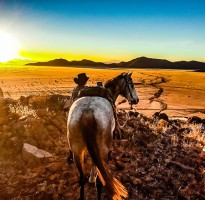
The Wadi Rum Desert in Jordan is called ‘The Valley of the Moon’. Having ridden the lunar landscapes of Iceland as well as the dramatic landscapes of America’s Southwest, I found the Wadi Rum to be a mix of the two. It’s much more diverse than the moon with its variety of pink, red and white sandstone formations, striated with lines of black, pockmarked with crevices and decorated with 2500 year-old petroglyphs. The desert is stunning with surprisingly diverse scenery. There are areas of rocky sand mixed with large sand dunes, prickly green shrubs and imposing mountain monuments rising up to bright blue, cloudless skies. Dramatic… beautiful… and I wouldn’t want to ride there without a guide, as weaving through those canyons, I would certainly get lost. You might want to get lost, as the desert is magical, but not during the midday heat! I quickly learned from the Bedouins to always be on the lookout for shade. As my Arabian horse’s hooves sunk into the sand, I really appreciated being on horseback for my trek. If you’ve even walked on the beach, you know that it can require greater effort. It’s the same for maneuvering through the desert. I was looking forward to covering a lot of ground and horseback riding seemed the best way to do it. Many people know of the Wadi Rum from the 1962 epic film Lawrence of Arabia, as much of it was filmed in this desert. I did sort of feel like Lawrence as my Bedouin guide, Atallah, pointed out the grand The Seven Pillars of Wisdom rock formation in the distance. It was named because of the book written by British officer T. E. Lawrence, who was based in Wadi Rum during the Arab Revolt of 1917–18.
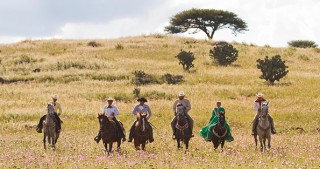
Atallah, our guide, is a Bedouin who leads riders on tours of the desert on his well-built Arabian horses. He grew up in the Wadi Rum and knows the land instinctively. His horses do too, having been conditioned to conquer the desert extremes. There are only certain places where the sand allows for faster riding, so we took advantage. As we took off at a canter through a flatter area of more compact sand, I experienced the strength of my horse, Chams. I was in the lead beside Atallah, who is also a world-class endurance rider, using all of my strength to keep Chams in check while we raced between two large sandstone rock formations. I ride horses all over the world, but I was a little nervous to ride Arabians in the vast, open desert. As a breed, Arabians are known to be more spirited and "hot-blooded." They have been bred for speed. It's the Bedouin who are thought to be some of the original breeders of the Arabian horses. These horses and their Bedouin owners know the desert, having adapted to live here for generations. As a traveler coming in to ride for a few days with them, this can exciting and daunting. Atallah buys and breeds his Arabians. He races throughout the Middle East and Europe, riding his Arabians in prestigious endurance races. Atallah’s horses certainly were spirited, but they also listened, giving me confidence in the sand.As Chams began to inch forward past Atallah, my heart began to beat quickly as I pulled the reins back, cueing Chams to slow down. Chams listened, but I could tell that he was in racing mode. I felt scared and exhilarated, as we raced towards an area with more rocks, where we'd be forced to slow down because of the footing. I was out of breath as we slowed to a walk. I looked over at Atallah, who had a big smile. He was in his element. I hoped that by the end of my time riding with Atallah, I'd be there too.Our group of five consisted of four Bedouins and me. In the extreme heat and sun, I covered my head with a scarf, which I am still learning to properly tie. There are many different ways to tie a headscarf. At first, I thought that this would make me even warmer, but by the end of each day, I was happy to have it. Even though I was there at the end of September, a good time to ride in Jordan, temperatures can still soar in the desert. We would rise early to ride and break for many hours for lunch, finding refuge under the shade of a canyon. The Bedouin are masters at finding shade. Whenever we had the chance, we would make for a canyon to ride among the shadows, for our benefit and for our horses.
At lunch, my Bedouin friends would lay out mats on the sand, light a fire and cook simple but delicious meals, followed by piping hot chai, tea with various herbs and spices. For lunch on our first day, Ibrahim, a Bedouin guide who also rode with us, sliced tomatoes, onions and garlic and sautéed it with beans, oil and a multitude of spices. It sounds really simple, but it was so good. We ate without silverware, tearing off smaller pieces of pita bread and shaping them into spoons. We used bread to scoop up the tomato concoction. I savored it, along with the water and hot chai. Then, everyone laid down and slept in the shade until it was cool enough to ride again. I’m not one for napping, but as I sat with my boots off in the shade and quiet of the desert, starring at the horses grazing and feeling drowsy and full, I dozed off for a few minutes. When I arose, I saw a string of camels in front of me, crossing the desert like a mirage in the distance. I got up quickly, just in time to photograph them. Camels are also a good way to trek the desert, and one that I’d experience later in the trip. Their broad, padded feet don’t sink into the sand, unlike horses, but I prefer the latter because I find they are easier to control. Maybe that’s because I’m used to them.
As we continued our ride into Lawrence Canyon one afternoon after lunch, I was astounded by the abundance of life in the desert. There was a lot more greenery than I imagined, and like everything the desert gives you, the Bedouin use these plants to their advantage. Atallah pointed out a bush that he crushes and uses as a natural soap, desert Purell. There was an abundance of the prickly Haloxylon shrubs, which have deep roots that help hold the desert sand in place. I saw lizards scurry across my path, leaving delicate tracks alongside the tracks of Ibex, a wild goat with distinctive ridged horns. The Sinai Rosefinch, Jordan’s national bird, chirped in a secluded section of a canyon, revealing its small sparrow-sized body and its bright pink chest.
We ended our day at Atallah’s private camp, with its spacious black Bedouin style tents woven of goat hair. Atallah told us that it took his mother eight years to weave these tents. I was able to walk in and out of these tented bedrooms. They were tall enough that I didn't have to navigate in on my knees. There was a queen mattress in one and colorful carpet covering the ground. (Watch a video tour of the camp) I was so tired after riding all day in the desert that the music and laughter around the campfire that night didn’t bother me. The five AM wake up call to ride camels at sunrise, however, did. Purchase Equitrekking DVDs, the Equitrekking Travel Adventures on Horseback book and horse gift itmes at ShopDarley.comLearn more about riding in the Wadi Rum in Jordan on an equestrian vacation at EquitrekkingTravel.com.Comments
Interesting experience... Wadi Rum is such a fascinating place!
Login
Login to your account in order to be able to comment on this and other blog entries.Get answers to any questions that you may have, or simply make your opinions known.
Login
Get answers to any questions that you may have, or simply make your opinions known.